 SPOT.
House Sessions #001: Arian Zand on music and discovering events
With House Sessions we bring music and people together. For this first session we used SPOT to organise a private event where Lowie Trio and Arian Zand played a DJ set together in the living room. A night full of electronic music, a shared passion for the music scene and, above all, good company.
Listen to the mixtape by Arian Zand & Lowie Trio on SoundCloud →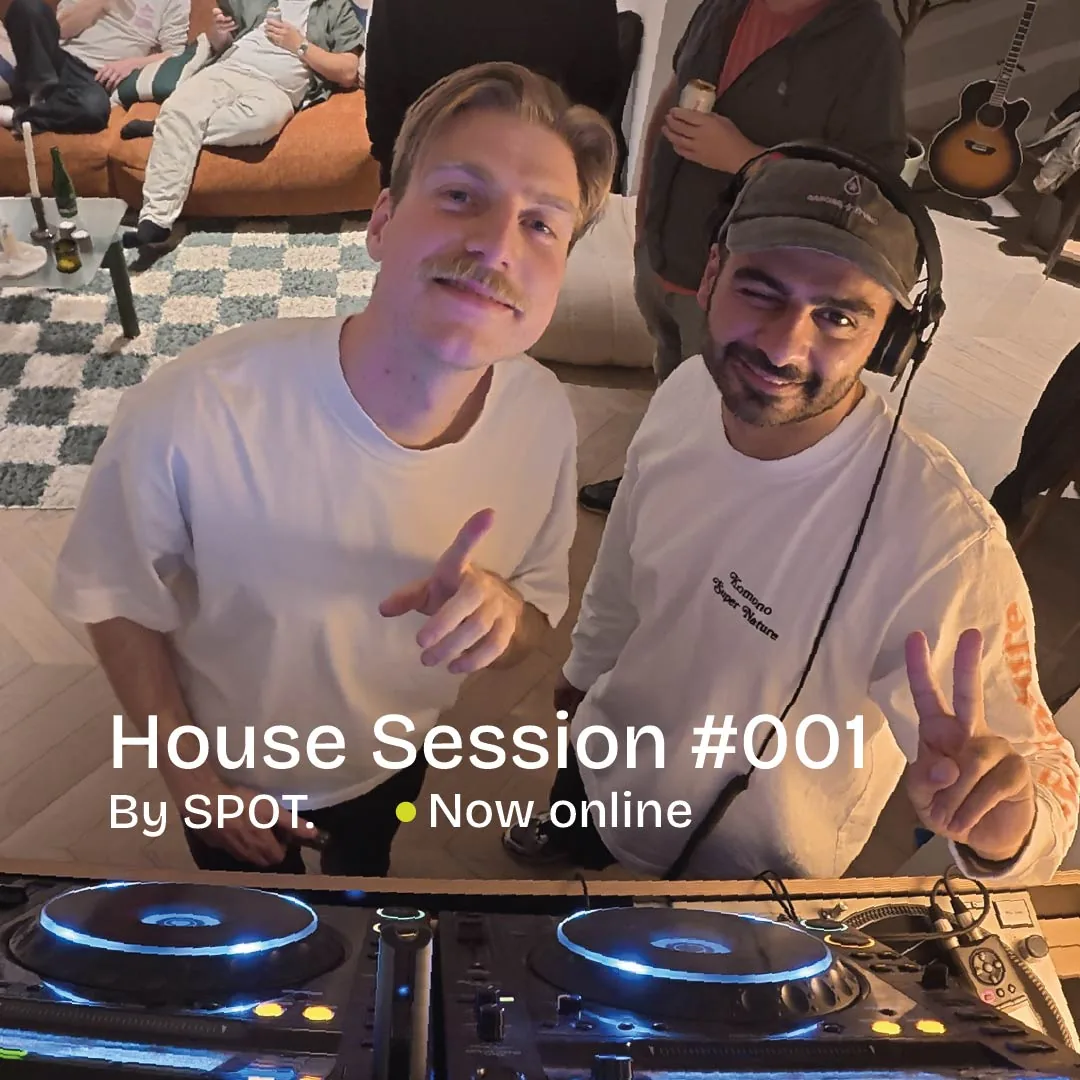
With SPOT we want to make it easier to discover new events, meet like-minded people and see what's happening around you. But how does someone who is active in the music scene themselves experience that search for unique events?
We asked Arian Zand. He talks about how findable events are, what makes a night unforgettable, his musical inspiration and the work that happens behind the scenes of events.
Discovering events in a fragmented landscape
The offer has never been bigger, but it has also never been so fragmented. There's no longer one central place where I can find all the events for me. There are also many more niche genres and small collectives doing their own thing, and those are exactly the nights that interest me most. But they're often hidden in an Instagram story, a group chat or a flyer. If you don't follow the right people, you miss it!
Facebook used to show you what was going on, and above all who was going. But I stopped using Facebook a long time ago, and I don't think I'm the only one. Since then a gap has opened up.
That's why I find SPOT interesting. You discover events based on what matters to you, instead of what a platform wants to show you. And you also see which friends are going. In the end, that's what makes an event worthwhile for me: the music, but also the people you're there with.
What makes an event unique?
For me it always starts with the music programming. A good event dares to make choices. It brings together artists who reinforce each other and gives room to names you don't know yet. As a DJ, and as someone who has co-founded collectives myself, I know how much work goes into that. You notice it as a visitor too.
Then there's the experience. A night needs a flow: how you come in, how the energy builds, how the sound feels, how the staff and the crowd interact. Those are small things, but together they decide whether you feel at home somewhere.
The interior and the styling inside a club are often underrated, but lighting, décor and how a space is arranged change everything. The same room can feel like a completely different place. When an organisation really pays attention to that, you feel that they care about their audience.
Why do I go back? Because those three things together create a world of their own. After a few times you know the people, you recognise the vibe and you know you won't be disappointed. Then an event becomes more than a night out. It becomes a community you want to be part of.
Events on the radar
More generally, I try to keep a better eye on events in Brussels. There are so many collectives and small initiatives active there. But those are exactly the hardest to find when you don't live there, which is a shame, because that's often where the most surprising nights are.
Three tracks that reflect my musical style
My style sits between house, tribal and Middle Eastern music. I like to select music with percussion, where tempo plays less of a leading role.
Cinna Peyghamy – In A Deep Slumber
Cinna is an Iranian dombak player who makes experimental music. That ties in with what occupies me: my Iranian roots and how traditional sounds find a place in electronic music. A track that's ideal during a radio set or a downtempo session, where there's room to really listen.
Sequential – Quitamela (RPO & Darmon D Part 1 Mix)
A house track from 2008 with lots of percussion and Latin American influences. That's exactly the kind of thing I keep coming back to in my sets.
Aida – Collective Coma
Aida is an Iranian DJ and producer who inspires me enormously when putting together my DJ sets. For me, this track is the perfect way to close a night.
The work behind the scenes
Behind every event there's a lot of work that you don't immediately see as a visitor. You see a line-up, a venue and a few hours of music, but one night often takes months of preparation.
It starts with the selection. Putting together a good line-up means looking for artists who fit together, are available and stay within budget. Then come the bookings, contracts, technology, sound, lighting, safety, volunteers and the build-up. Every part has to be right, otherwise you feel it on the night itself.
What people underestimate most is the business side. Ticketing, payments, invoices, permits and settlements with artists: it's not sexy work, but without it there is no event. Especially for small collectives the margins are often very tight. Many organisers do it alongside their job, purely out of love for the music.
And then comes the communication. You can organise the most beautiful event of the year, but if it doesn't reach your audience, you're standing in an empty room. Being visible is a craft in itself these days, and for smaller organisations that's one of the hardest parts.
Looking for your next events?
SPOT. is free for iPhone and Android.